
Scott County Warrant Searches
The county's official channel for Circuit and Superior Court arrest warrants is the Scott County Sheriff Warrant page. It has carried a "Warrants Offline For Maintenance" notice. That message blocks access. It does not tell you whether a Scott County warrant exists. When the page works, the sheriff's FAQ says warrant information may include the warrant date, the charges, the bond amount, and the issuing court. The web disclaimer also warns that online material cannot be certified as fully accurate or authentic. A complete Scott County warrant check therefore leans on more than one source. Keep a full legal name, date of birth, citation or cause number, and an approximate case date at hand. Never go to a controlled facility on a web result alone. Call first. Ask which court issued the process. Consider legal advice before arranging a surrender or filing anything with the court.
- Check the official sheriff warrant page for its current availability.
- Search Indiana MyCase by cause, citation, cross-reference number, or party name.
- Read the chronological case summary for warrant, FTA, service, recall, bond, or hearing events.
- Call the Sheriff at 812-752-8400, a 24-hour line, for current enforcement confirmation.
- Contact the Clerk for the official case file, balance, copies, or a record that is not online.
Scott Sheriff Page Is Offline
A maintenance notice changes the order of a practical search. No one can inspect the page's current form, field list, update schedule, or result roster while it is down, and no search controls appear there. Scott County residents should not wait for the portal to return when a court date, a planned trip, or a voluntary surrender needs a prompt answer. The fallback is the Scott County Sheriff's Office at 111 South First Street in Scottsburg. Its public number answers around the clock. Administrative hours run Monday through Friday, 8:00 a.m. to 4:30 p.m. Ask whether the office holds a warrant from Scott Circuit Court or Scott Superior Court, and which court controls the next step. Records owned by a different police agency stay with that agency.
Current access note: An offline Scott County warrant page does not establish that a person has no active warrant.
What a Warrant Search Asks For
The sheriff form was unavailable, so its exact fields cannot be stated as fact. The working field set comes from MyCase and the Indiana Judicial Branch search tips. A cause or citation number beats a name every time. For a party search, the last name is the anchor; add a first name, middle name, or date of birth to narrow common-name results. Date of birth helps match a record but does not appear in public Scott County case details.
| Field Label | Type | Required | Notes |
|---|---|---|---|
| Case, citation, or cross-reference | Text | One for number search | Hyphens and leading zeroes may be omitted |
| Last name | Text | Party-search anchor | Wildcards are allowed |
| First and middle name | Text | No | Narrows likely matches |
| Date of birth | Date/text | No | Narrows results but is not shown publicly |
| Court | Dropdown | No | Use 72C01 Circuit or 72D01 Superior |
| Status and file dates | Filters | No | Open or closed status does not settle warrant status |
A captcha may appear. Results are capped at 1,000. The sounds-like control can help with name variants, but these are case-search tools, not a promise that every Scott County warrant record will appear.
MyCase Is Not Warrant Clearance
The Indiana court warrant FAQ says MyCase may show a warrant in a case summary when the case is included and not confidential. It also says Indiana has no public website for searching all arrest warrants. MyCase can miss a new event. It can miss a confidential case, a record excluded by court order, or a warrant held by another agency. Read the event history, not just the case label. An open case does not prove an active warrant. A closed label does not prove each warrant event was recalled. Look for an order issuing a warrant, failure to appear, service, recall, bond action, or later compliance. Then confirm the current state with the office that owns the record. Scott Circuit Court and Scott Superior Court feed the local court route. IDACS and NCIC are law-enforcement systems, not public self-search tools. Indiana's INcite tax-warrant service covers tax liens, not criminal arrest warrants.
Scott County Warrant Search Results
The Sheriff's published FAQ verifies four fields it can provide: date, charge, bond amount, and issuing court. A cause number or service status may appear in a court summary. The sheriff page's downtime left its warrant-number format and live result layout unconfirmed. Scott County uses Indiana uniform case numbers. No local warrant-number pattern should be inferred.
| Case or cause number | If shown, an Indiana court identifier such as 72C01 or 72D01 routes the case to Circuit or Superior Court. |
|---|---|
| Warrant date | The issue date reported by the Sheriff; ask whether later service or recall activity exists. |
| Charge | The charge description tied to the court process, not a finding of guilt. |
| Issuing court | The court that controls hearings, filings, and any recall order. |
| Bond | The published amount and type, if set; confirm before arranging payment. |
| Status event | Issued, served, recalled, or another docket event when the source displays it. |
Use the field set to form clear questions. Ask whether the Scott County warrant is active now, which court controls it, what bond type applies, and what step the court requires. Posting bond addresses release. It does not end the case.
Scott County Clerk Record Fallback
MyCase is not the whole story. In Scott County, the Scott County Clerk’s Office keeps the official case record for both county trial courts. You will find it at 1 East McClain Avenue, Suite 120, Scottsburg, IN 47170. Call 812-752-8420 Monday through Friday, 8:30 a.m. to 4:30 p.m. Staff can track down a cause number, a traffic balance, the next setting, or a record that never appeared online. Every request goes through the Clerk’s Public Records Request form. The published fees are simple. Copies cost $1 per page. Certification adds $3. A chronological case summary runs $1 per page. Out-of-state searches carry a separate charge. Nothing is posted for a warrant-status phone call, so ask before ordering. Sheriff records follow a separate route. The Scott County sheriff FAQ requires you to pick up its form at the office, and the responsive record is ready the next business day after you return it. The sheriff states no processing fee. A separate $10 statement applies to a picked-up criminal background response. Do not treat that figure as a warrant-only fee.
Scott County Warrants: Who Holds What
Scott County runs its trials through two courts. The state directory lists only Scott County Circuit Court and Scott County Superior Court as local trial courts. Circuit sits in Suite 212 and answers at 812-752-8430. Superior sits in Suite 252 and answers at 812-752-8424. Both share the county complex at 1 East McClain Avenue. The Clerk holds their court files, while the Sheriff maintains and serves their arrest warrants. Keep that split straight. No Austin or Scottsburg city court, municipal court, county court, or justice-of-the-peace court appears in the directory. A city police department may keep its own incident record. Even so, a city-issued citation can still route into the county court and Clerk system. Start with the agency and court printed on the ticket. When the cause belongs to Scott Circuit or Scott Superior, work through the Clerk and MyCase. Traffic matters have one more channel. The county’s Traffic Tickets page asks you to contact the Clerk for the cause number and amount, and it gives payment and denial-form paths. It is not a public traffic-warrant search. Indiana posts no statewide fallback list either. Direct county confirmation stays essential.
No Result Is Not Clearance
A blank result is not clearance. Several gaps can hide an active warrant. The sheriff page may be offline, or the warrant may be new, sealed, or held by another agency. Sometimes the court pulls an arrest-warrant case from public view to cut flight or harm risk, and MyCase may simply lack the case or event. Common names cause misses too, especially when a Scott County record was filed under a different spelling. A careful Scott County warrant check works around this. Test the likely cause number, narrow party results with date of birth, and try the sounds-like option when the name could be entered another way. Then call the right office. City police go to that police agency, the court file goes to the Clerk, and current service status on a Circuit or Superior arrest warrant goes to the Sheriff. Write down the date and the office for any direct confirmation, since a saved result can go stale. Ask what court step comes next, and for a current entry see the Scott County active warrant search explanation for status and clearing routes.
Which Warrants Stay Restricted
Indiana court records are open in general, but not everything is public. Rule 4 sets the general access rule. Rule 5 governs the exclusions. Confidential cases, juvenile-related material, investigative process, sealed or expunged records, and some active arrest-warrant cases may stay closed. Rule 5 permits temporary exclusion when an arrest-warrant case is filed with a request to keep it from public view. Access may reopen after arrest. A court can extend the restriction instead. Search-warrant materials can also stay confidential as investigative process. A Scott County file answers to these same rules, and the limits protect safety and investigations rather than signaling a search error.
Key rules:
A confidential or excluded Scott County warrant record will not become public just because a person asks the Sheriff or Clerk.
Juvenile and sealed records remain subject to court-access limits.
Absence from MyCase or the sheriff page is not proof that no warrant exists.
Two rulebooks govern denials. Indiana’s Access to Public Records Act covers agency records, while the Indiana Rules on Access to Court Records govern court files. Ask the Scott County record holder which rule controls a denial and whether a public portion can still be released.
Prepare for a Sheriff Call
A focused call avoids mixed names and cases. Have the exact legal name, date of birth, any prior name, the approximate incident or citation date, and the cause or citation number if you know it. Say whether the matter may involve Scott Circuit Court, Scott Superior Court, Austin Police, or Scottsburg Police. Then ask the right questions. What is the warrant date? Ask for the charge description, the issuing court, the current status, and the bond amount or type. Find out which office controls the next action. The Scott County Sheriff may confirm enforcement status. Only the issuing court controls recall or new settings. Court staff can share records and process details, but they cannot give legal advice. Before visiting the Security Center, confirm timing and identification needs. The facility is controlled, and the Sheriff lists no dedicated walk-in warrant window. Anyone weighing voluntary surrender should talk with counsel when possible and coordinate with the Sheriff here in Scott County. That call is civic information and a safer route, not a promise that an arrest will be avoided.
Scott County Search Interfaces
Indiana's official MyCase portal is the public search screen for tracking any Scott County court case.
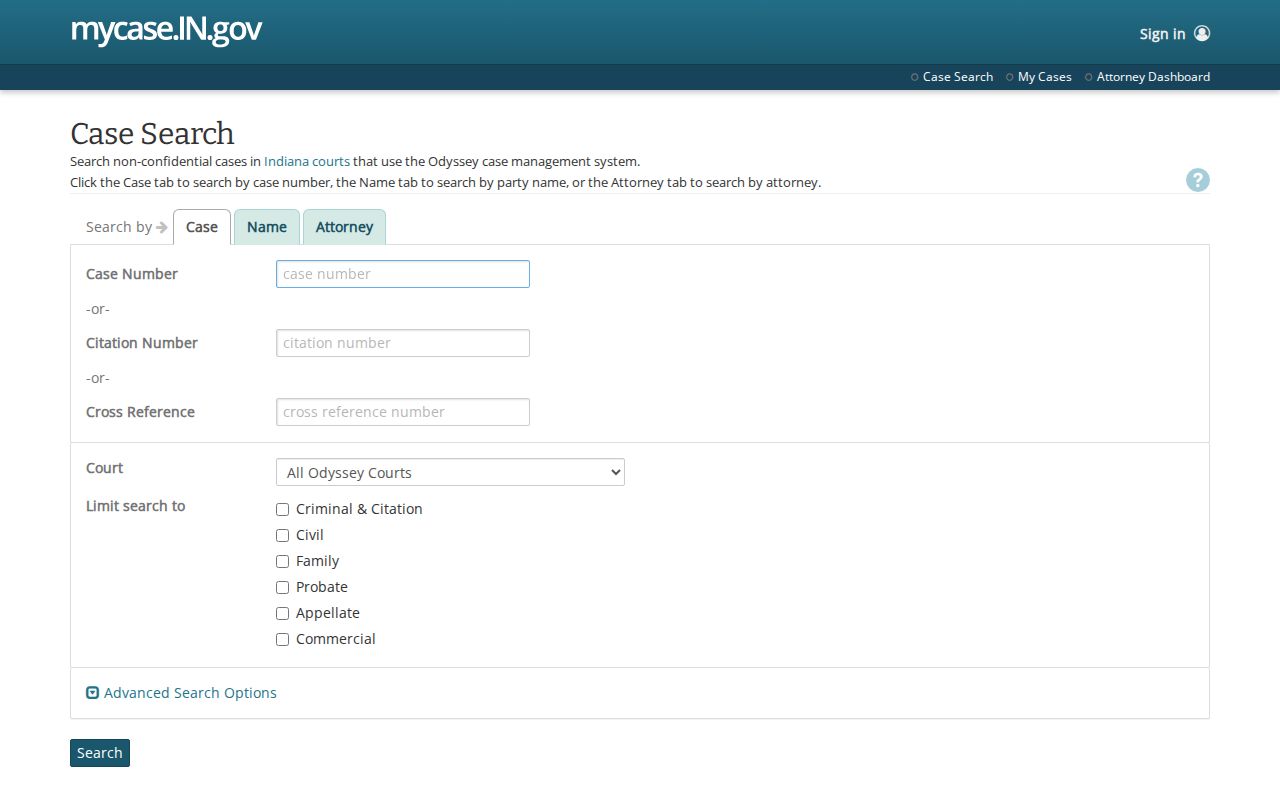
A result list alone settles nothing in Scott County. Open the matching docket and read the events, because a case-search hit is not warrant clearance. The official MyCase field guide covers number searches, party-name fields, date-of-birth narrowing, and court filters.
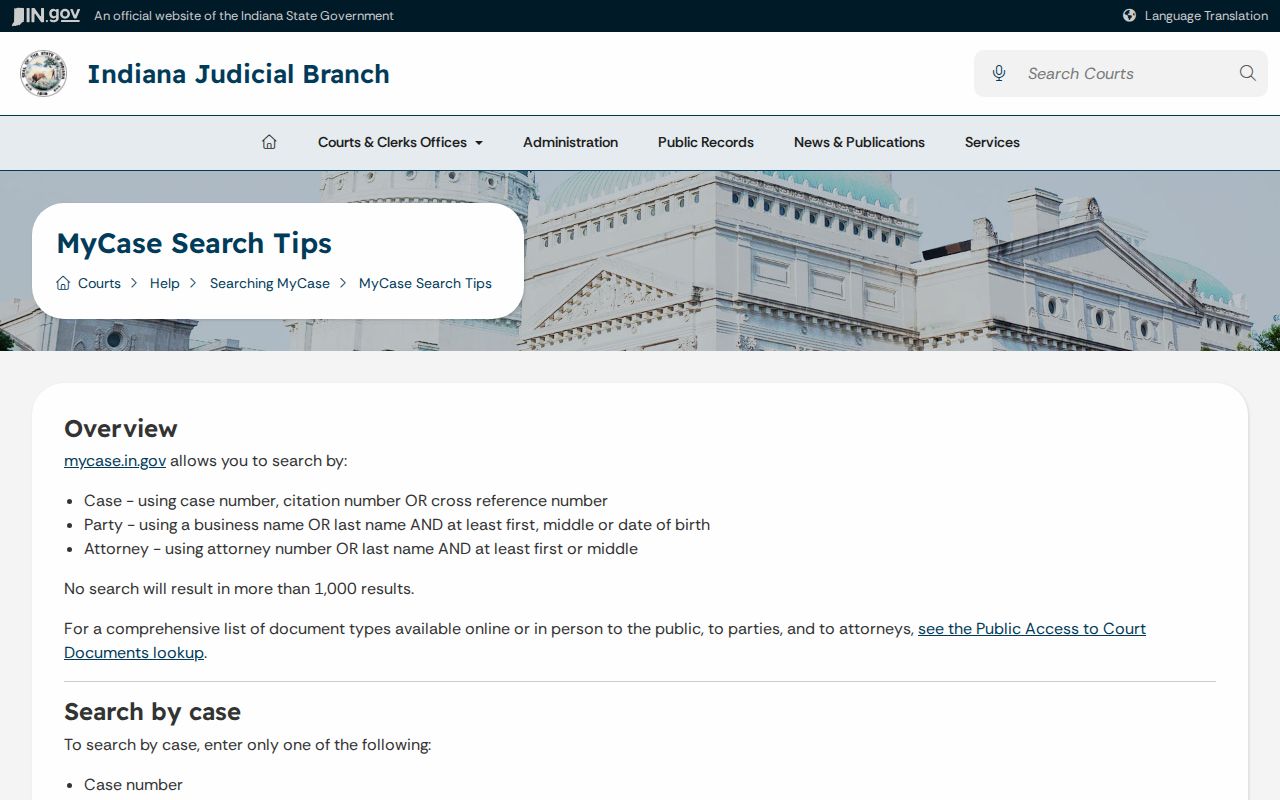
Those controls make a Scott County warrant check more precise. Still, only the Sheriff or Clerk can confirm the current record.