
How Bench Warrants Work in Scott County
Scott County public materials tend to say "bench warrant" or "failure to appear," shortened to FTA. Neither one is a capias pro fine product. The trigger can be a missed criminal hearing, an unanswered traffic summons, noncompliance with a court order or release condition, or a no-show after bond. State pretrial rules define FTA as a court-issued warrant that follows a defendant's nonappearance. Once issued, it lets law enforcement bring the person before the judge. It settles nothing by itself. The underlying case and the missed duty remain for the court to address. Child-support and juvenile matters follow their own access rules and procedures. Treat those case by case. Scott County posts no dedicated bench-warrant list. The public route starts with MyCase. From there, ask the Clerk and the court for the official file, and the Sheriff for current enforcement status.
Scott FTA and Bench Terms
Scott County docket words carry weight. "FTA" is short for failure to appear. A "recall" withdraws a warrant by court order, and "quash" is another way of saying set aside. "Served" means law enforcement executed the warrant, while "bond forfeiture" can follow when a person breaks the release terms attached to a bond.
- Bench warrant
- An order issued from an existing court matter after a missed duty or nonappearance.
- FTA
- Failure to appear for a required hearing or failure to answer a summons.
- Recall or quash
- A court action that withdraws or cancels the warrant.
- Cause number
- The Indiana court case number used to locate the official file.
- Bond
- Terms for release from custody; bond does not end the underlying case.
Not every unpaid fine is a capias. Scott County sources do not support that shortcut, so copy the exact term from the case record and ask the Clerk what the judge ordered.
Bench Warrant Issuance in Scott County
A Scott County judge signs bench process after a recorded failure tied to the case. The Clerk then issues the warrant, writs, and other process on the judge's order. The order may show up in the chronological case summary. It then heads to the Sheriff for service. Warrants do not expire on their own. Only service, a recall, a quash, or another court order closes one. Scott County Circuit Court and Superior Court handle the criminal and traffic path. The Sheriff's FAQ says the office maintains arrest warrants from both courts. No office here promises a grace period. There is no mailed warning, no automatic expiration date, and no routine walk-in recall docket. Don't borrow another county's practice. A missed traffic answer adds a state-law path. Under Indiana Code 9-30-3-8, a court may issue a warrant after a failure to appear or answer, and if the warrant is not executed within the statutory period, the court may send FTA information to the BMV, which can suspend driving privileges until the case reaches the required disposition.
Find Scott County Docket Events
For a Scott County warrant check, MyCase searches by cause number, citation number, cross-reference number, or party name. Party searches start with a last name. Then narrow it with a first name, middle name, or date of birth. The state search tips also document wildcards, a sounds-like control, and court, status, and file-date filters. Where the interface permits, limit results to Scott Circuit Court, identifier 72C01, or Scott Superior Court, identifier 72D01. Next, open the chronological case summary. Scan it for an FTA, warrant issue, service, recall, bond, hearing, or compliance event. Open or closed status alone means little. MyCase is not a public statewide warrant search. Its display is not the official record either. A confidential case, a new entry, a temporary exclusion, or an agency-held warrant may be absent. The Sheriff warrant page can also go down for maintenance, so confirm anything important with Scott County directly.
How Bench and Arrest Warrants Differ
Both orders can end in arrest, but they start differently. A bench warrant usually grows out of an existing case and a missed duty. An arrest warrant generally follows a judicial finding of probable cause tied to an alleged offense. Scott County judges issue either one. Deputies may serve both.
| Feature | Bench Warrant | Arrest Warrant |
|---|---|---|
| Trigger | Missed hearing, failure to answer, or noncompliance | Probable cause tied to an alleged offense |
| Underlying matter | Usually an existing court case | A complaint, charge, or other charging basis |
| Who controls recall | The issuing judge or court | The issuing court controls court action |
| Practical response | Confirm, seek counsel, arrange reset, bond, appearance, or filing | Confirm, seek counsel, coordinate surrender and bond if applicable |
A traffic FTA in Scott County is its own kind of missed-answer or missed-appearance problem. It can trigger BMV action too. Don't confuse it with a driving record.
No Separate Scott JP Counter
Start with the official list. The Indiana Judicial Branch Scott County directory names three offices: Circuit Court, Superior Court, and the County Clerk. No Austin City Court appears. No Scottsburg City Court, municipal court, county court, or justice-of-the-peace court is listed either. So skip the hunt for a local JP warrant desk. A ticket from Austin Police or Scottsburg Police can still land in the county court system, so read the agency and court printed on the paperwork. If the cause number points to Scott Circuit or Superior Court, use MyCase and the Scott County Clerk. A city police record and a county court record stay separate requests. That split is easy to follow. File questions go to the Clerk. Procedure questions go to the named court. Enforcement checks on court warrants the Sheriff maintains go to its 24-hour line, and any other police agency answers for its own records.
Clearing a Bench Warrant in Scott County
Call first. Ask the clerk. Confirm the warrant, the cause number, the issuing court, the bond, and the process the judge requires before you appear in Scott County. The court may want a reset, a personal appearance, payment, bond, or a motion filed by a lawyer, and no recall form, amnesty program, or standing walk-in bench-warrant docket exists here.
- Call the Sheriff at 812-752-8400 for current enforcement status.
- Contact the Clerk at 812-752-8420 for the official cause number and case record.
- Consult counsel about surrender, bond, a new setting, or a motion to recall or quash.
- Follow the issuing court’s exact directions and resolve the missed duty.
- Afterward, confirm that the court docket and Sheriff status both changed.
Caution: Do not ignore a Scott County bench warrant; it can lead to arrest during a traffic stop or other police contact.
Call the Scott County Public Defender at 812-752-5920. Court staff can explain records and process but cannot give legal advice.
Ask About Bond or Reset
Two questions usually control the next step. You need to know whether bond is set and whether the court will reset the hearing or require a filing. The Sheriff's FAQ says voluntary surrender occurs and that the office will seek reasonable accommodation within law and policy. That language promises neither release nor cancellation. If bond is set, confirm the amount and type before you bring funds. Scott County accepts weekday inmate bonds through the Clerk from 8:30 a.m. to 4:00 p.m. After hours and on weekends, Scott County routes bond transactions to a touch-screen kiosk in the Security Center lobby. Fees apply at the kiosk. The published page lists a $3.25 cash transaction fee and a 10 percent credit or debit transaction fee. Bond settles custody and release alone. It does not resolve the missed hearing or the underlying charge, and a reset only supplies a new setting. The Scott County court must still address the warrant. Ask what docket entry will show recall. Then ask when the Sheriff should receive the update.
Scott County Courts That Issue Bench Warrants
Only the issuing court can change its own order. Address matters here. The Scott County Circuit Court sits at 1 East McClain Avenue, Suite 212, Scottsburg, IN 47170, and answers at 812-752-8430. The Scott County Superior Court is in Suite 252. Its number is 812-752-8424. The Scott County Clerk works from Suite 120 in the same complex, open Monday through Friday, 8:30 a.m. to 4:30 p.m. Need the official file, a cause number, a traffic balance, or copies? The Clerk supplies them. The Sheriff's Security Center at 111 South First Street handles maintained-warrant confirmation and custody routing.
| Circuit Court | County criminal and traffic process; ask court-specific procedure. |
|---|---|
| Superior Court | County criminal and traffic process; ask court-specific procedure. |
| County Clerk | Official files, cause numbers, settings, copies, and traffic balances. |
| County Sheriff | Maintains and serves Circuit and Superior arrest warrants; confirms current status. |
Confirm Scott Warrant Recall
Never assume a payment, an appearance, or a lawyer filing ended the matter. Ask the Clerk what event now appears in the official chronological case summary. Confirm that the judge entered a recall or quash order. Then call the Sheriff and ask whether its warrant status reflects the court action. Traffic cases need a second check. Scott County says the Clerk sends notice to the BMV on the next business day after a ticket is paid. Some suspension types remain for an added period. Scott County warrant status and license status are separate. Confirm each with the right office. Keep records of each confirmation. Save the cause number, date, and office involved. A saved MyCase screen helps you track the case, though MyCase warns that it is not the official court record. If the court record is restricted, ask which public portion can be released under Indiana's court-access rules. For wider context, the Scott County warrant records overview explains surrender and bond routes without replacing advice from counsel.
Scott County Bench Warrant Offices
Scott County's official traffic instructions walk through a missed answer, Clerk contact, payment, and denial. See how each step fits local court process.
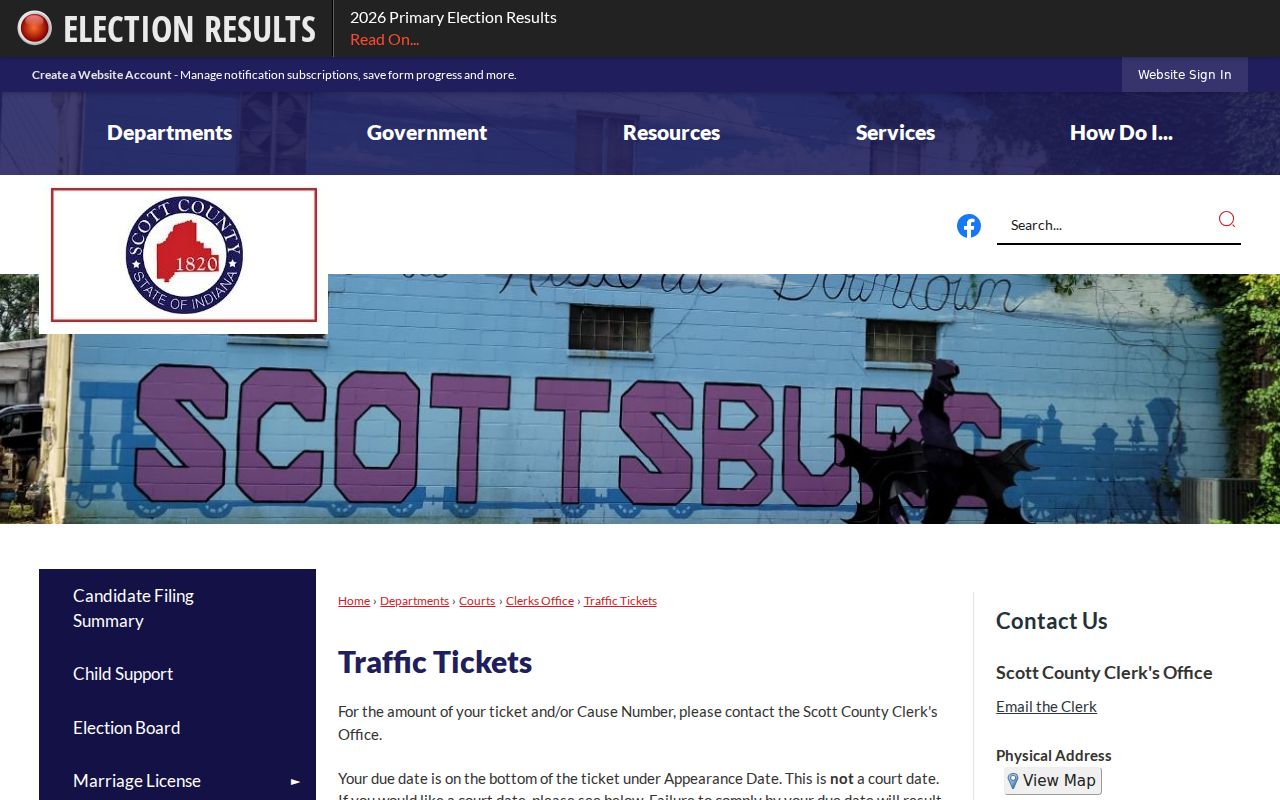
A ticket due date is not a court date. Cause-number questions go to the Clerk. The Scott County courts hub identifies the offices that route Circuit and Superior matters.
The directory backs the two-court route. No separate city or JP warrant counter is listed for Scott County. The Scott County Clerk page gives the record counter, request path, hours, and copy fees.
For any Scott County bench warrant, the Clerk holds the cause number and official docket while the Sheriff confirms maintained-warrant status.