
How Traffic Warrants Work in Scott County
The date printed beneath “Appearance Date” on a Scott County ticket is the deadline to respond. The official traffic-ticket instructions stress that this is a due date, not a scheduled court date. A person may pay, or may timely deny the allegation and obtain a later bench-trial setting.
Indiana Code 9-30-3-8 permits the court to issue a warrant when a defendant fails to appear or answer a traffic information and summons, or a complaint and summons. Scott County traffic cases follow the County Clerk and Circuit or Superior Court route. No separate city or justice-court traffic-warrant portal was found.
Scott County Traffic Warrant Ticket Dates
A common error is waiting to appear in a courtroom on the printed date. The date instead marks when payment or a denial must reach the Clerk. Missing it can start a failure-to-answer process, produce a Scott County traffic warrant, and lead to a notice sent to the Indiana Bureau of Motor Vehicles.
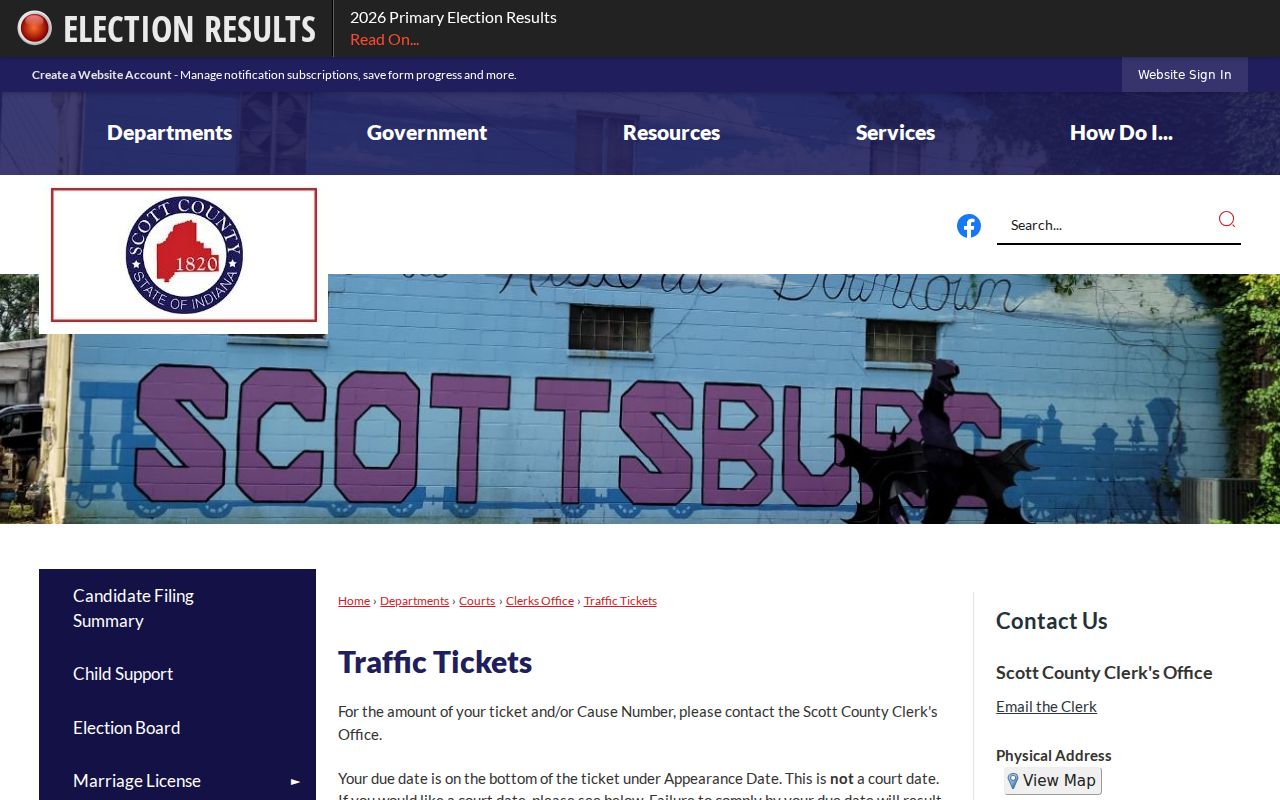
The official county traffic page displays the local deadline, payment, denial, and reinstatement rules.
Read the actual citation as well. Its cause or citation number is the best key for the Clerk's record.
Scott County Traffic Warrant Checks
There is no public Scott County traffic-warrant form that gives a complete yes-or-no answer. Use the court record first, then ask the offices responsible for the file and current enforcement. Have the legal name, citation number, cause number, and date of birth ready when needed to distinguish similar names.
- Review the ticket and search MyCase by citation, case, cross-reference number, or party name. It is a case search, not a warrant search.
- Call the Scott County Clerk at 812-752-8420 for the official amount, cause number, case status, and court route.
- Visit the Clerk at 1 East McClain Avenue, Suite 120, Scottsburg, during weekday office hours when a document or in-person transaction is needed.
- Call the Scott County Sheriff at 812-752-8400 for current local warrant confirmation. Indiana offers no single public statewide warrant database.
Search Scott County Traffic Warrant Cases
MyCase accepts a citation number, case number, cross-reference number, or party name. Date of birth, court, status, and date filters can narrow a result. The official search tips explain those fields and warn users to identify the correct case.
A case entry may show filings or a chronological event that points to an FTA. It still does not certify that a Scott County traffic warrant is active. The Clerk holds the official court record, and the Sheriff confirms current local enforcement.
Note: A missing MyCase result is not proof that a traffic warrant has been cleared.
Traffic Warrants: What They Show
The court file ties a traffic warrant to the citation and issuing court. Record the identifiers before making payment or asking for a new setting. Scott County has not published a special traffic-warrant number format, so do not infer status from the shape of a number.
| Cause / Citation Number | The citation number or court cause number links the ticket, payment, and case. |
|---|---|
| Allegation | States the traffic offense alleged on the ticket. |
| Issuing Court | Identifies Scott Circuit or Superior Court as shown in the case record. |
| Amount / Bond | The Clerk supplies the current amount or explains the court-controlled bond status. |
| Status | Shows case activity; confirm whether a warrant is active, served, or recalled. |
Names alone can match more than one person. Use the citation or cause number whenever possible.
The date of the warrant and the date of the ticket answer different questions. The ticket date identifies the original event, while a later warrant date marks the court's response to missed action. Ask whether the listed amount is a ticket balance, a bond, or both. Also confirm whether the warrant belongs to the case being discussed. A person can have more than one cause number, and paying one Scott County traffic case does not resolve another criminal or traffic case.
Scott County Traffic Warrant Payment Channels
Scott County accepts traffic payments in person by cash, money order, or credit or debit card. Card service fees apply. The Clerk does not accept personal checks or cashier's checks, and payments stop at 4:00 p.m. even though the office stays open until 4:30 p.m. for other work.
- Pay in person at the Clerk's office.
- Call Paygov at 866-480-8552 with the cause and citation numbers.
- Mail a money order to Scott County Clerk, Attention: Traffic, 1 East McClain Avenue, Scottsburg, IN 47170.
- Include a self-addressed stamped envelope when a mailed receipt is needed.
The Clerk's official page confirms office access and contact details.
Call first to confirm the current total and whether payment alone addresses the warrant.
Clearing a Scott County Traffic Warrant
The right route depends on whether the person accepts the ticket, disputes it, or already has a warrant. Indiana residents who deny the allegation must personally appear at the Clerk by the appearance date and sign a denial form. Circuit Court then sets a bench trial and mails notice. Out-of-state drivers may use the ticket's denial line by mail or call the Clerk for a form before the deadline.
- Ask the Clerk for the exact cause number, balance, court, and warrant status.
- Pay through an accepted channel, or timely file the denial that leads to a court setting.
- If a warrant already exists, ask the court or an attorney whether appearance or bond is required.
- After action, confirm recall with the Clerk and Sheriff and keep the receipt or order.
Warning: Payment or appearance must reach the proper court process. Do not assume a Scott County traffic warrant vanished merely because money was sent.
Scott County Traffic Warrant Denial Paths
A denial preserves the opportunity for a bench trial; it is not the same as ignoring the ticket. The defendant must follow the local form and deadline. Once the court mails a trial date, missing that later setting can create a distinct failure-to-appear problem.
Scott County also identifies a prosecutor deferral route for speeding less than 20 miles per hour over the limit. Commercial driver's license holders are not eligible under the published terms. Call the Prosecutor at 812-752-8466 to ask whether the case qualifies. Eligibility is not automatic, and applying does not itself clear an existing traffic warrant.
Note: A court-approved option must be completed on time to keep the case in good standing.
Before choosing between payment and denial, confirm what the ticket alleges and what the court requires. Paying generally disposes of the eligible citation on the court's terms. Denying it asks for a judicial hearing instead. Neither route should be chosen solely because a web result appears or disappears. The official Scott County court file controls the proceeding, and the Clerk can explain process and amounts without giving legal advice.
How Traffic Warrants Trigger License Holds
A warrant, an FTA court notation, and a BMV suspension are related but distinct. If a traffic warrant is not executed within 30 days, Indiana law directs the court to forward information to the BMV and mark the failure to appear. The BMV may suspend driving privileges until appearance, disposition, or payment after statutory notice.
| Mechanism | Trigger | Effect |
|---|---|---|
| Traffic warrant | Failure to answer or appear | Authorizes arrest through the court case |
| FTA notation | Missed required response | Records noncompliance and supports further action |
| BMV suspension | Court notice under state law | Suspends driving privileges until statutory conditions are met |
This distinction keeps the inquiry focused on court and warrant records. It is not a driving-history or insurance product.
Resolve each layer with the agency that controls it. The court recalls its warrant, and the Clerk reports the qualifying disposition or payment to the BMV. Ask what remains pending before treating the matter as closed.
Confirm Scott County Traffic Warrant Clearance
Scott County says the Clerk sends notice to the BMV on the next business day after a ticket is paid. That transmission does not mean every consequence ends at once. Driving-while-suspended and operating-without-financial-responsibility citations remain suspended for an additional 90 days after payment under the published county guidance.
The Scott Superior Court page identifies one of the county courts that may hold the case.
After paying or appearing, ask the Clerk whether the warrant was recalled and the BMV notice was sent. Then ask the Sheriff whether its enforcement status has updated.